
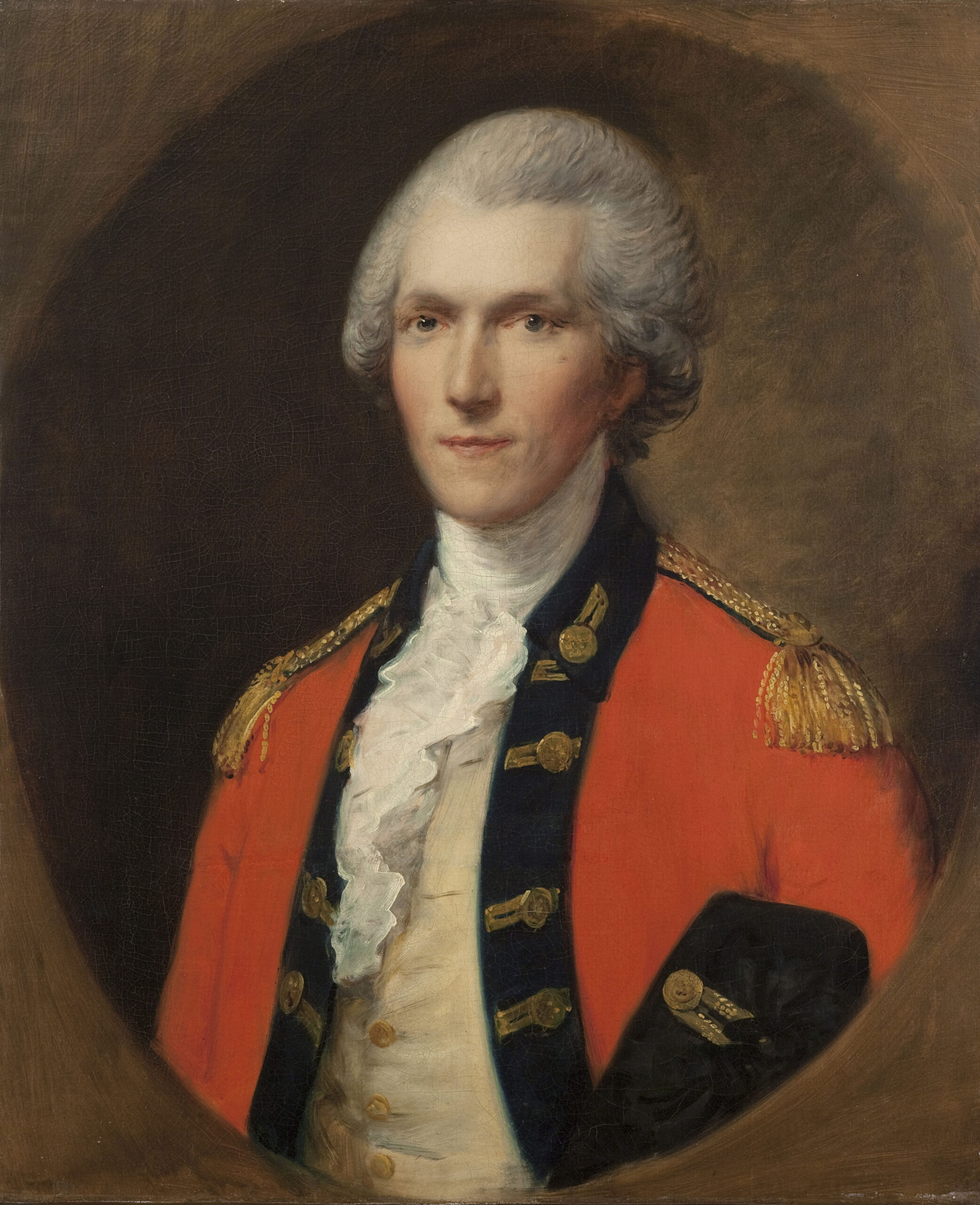
Portrait of Benjamin Thompson, Count Rumford (1753-1814) by Thomas Gainsborough, 1783, New Hampshire Historical Society.
25 Stories for 250 Years
Contributed by New Hampshire Historical Society

Scientist, soldier, spy—Benjamin Thompson was a colorful character in New Hampshire’s Revolutionary history. He married into Concord’s prominent Walker family in 1772. The marriage raised his social status and put him in influential circles. When war broke out, Thompson sided with the British, even though the Walkers were patriots. In 1775, Thompson heard there were plans to tar and feather him, so he borrowed a horse from his father-in-law and fled south to the British forces stationed in Boston. He never returned to New Hampshire or saw his wife, Sarah, again.
After fleeing New Hampshire, Thompson settled temporarily in his hometown of Woburn, Massachusetts. From Woburn, 10 miles outside of Boston, he sent information about American troop movements to his contacts in the British Army. He disguised his reports with secret ink comprised of tannic acid made from nutgalls, which grew in oak trees around Woburn. The ink was made legible by a treatment based on the chemical ferrous sulphate. A letter Thompson sent to the British in May 1775 is the earliest known instance of the use of secret ink in the American Revolution.
Thompson evacuated Boston with the British forces in March 1776 and eventually became a British officer. After the war, Thompson lived in Europe, where he developed new types of lamps, stoves, and fireplaces, and pioneered the idea of the soup kitchen. For his achievements, Thompson was ennobled as a count of the Holy Roman Empire in 1791, choosing for his name “Rumford,” which was the original name of Concord. Hence, he became Count Rumford.