25 Stories for 250 Years
Contributed by Wright Museum of World War II

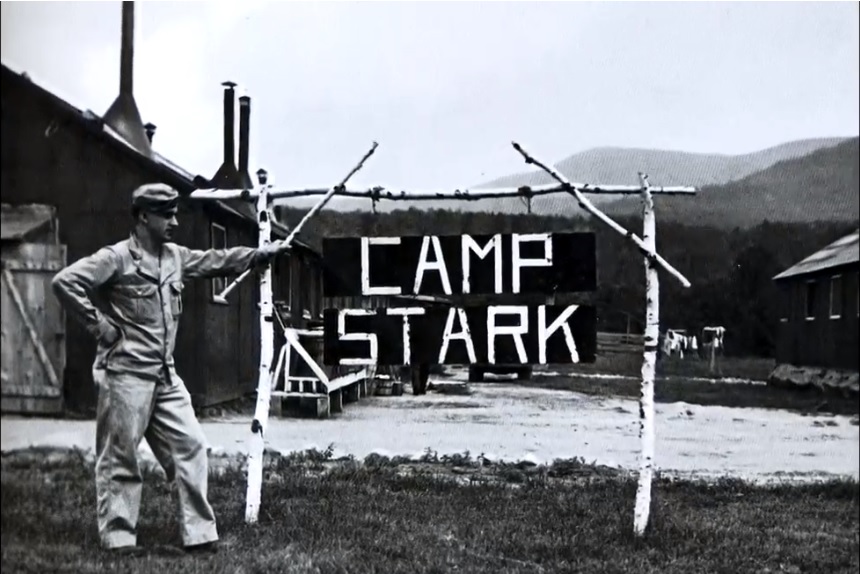
During World War II, the woods of New Hampshire concealed a small but significant piece of wartime history: a prisoner of war (POW) camp. Operational from 1944 to 1946, the camp housed around 250 German and Austrian POWs captured primarily in North Africa. The camp was known as Camp Stark.
In line with the Geneva Convention, the U.S. adhered to strict guidelines to ensure humane treatment. This included providing POWs with adequate food, shelter, and medical care. The camp was created by repurposing a former Civilian Conservation Corps site.
Camp Stark’s isolation in New Hampshire’s north woods meant escape was considered unlikely. Also, many of the prisoners were dissidents who had been pressed into service by the Nazi regime to “redeem themselves,” meaning they were content to remain in the camp and out of the war. Because of these factors, security was relatively minimal. However, a few POWs did attempt to escape. One notable escapee, Franz Bacher, managed to make it all the way to New York City before he was eventually recaptured.
The primary work assigned to the prisoners was cutting trees in the surrounding forests, a task crucial for the local economy. The lumber was needed by the Brown Paper Company for pulp production. Prisoners sometimes worked alongside members of local communities, and many even developed friendships that would continue beyond WWII.
After the war, the War Department returned most POWs back to their home countries as part of post-war agreements, though at least 5 eventually became U.S. or Canadian citizens.
In 1986, former prisoners and locals held a reunion, providing a space to reflect on their shared experiences and the unusual chapter of their lives spent together in the woods of New Hampshire.
The story of Camp Stark serves as a reminder of the complex realities of wartime life and the often-overlooked stories of those who lived through them. Its legacy is a testament to the resilience of the human spirit and the intricate interplay of wartime protocols and human interaction.