Chartered as a nonprofit entity in 1985 as Portsmouth Submarine Memorial Association, Albacore Park Submarine and Museum—as it is better known—recently welcomed Patricia Violette as executive director.
With more than twenty years experience in nonprofit management and museum leadership, including stints at Shirley-Eustis Historic House in Boston and Mt. Kearsarge Indian Museum in Warner, NH among others, Violette expressed enthusiasm at her latest position.
“I’ve always had a military kinship with the Navy, as my father served his 20 years during WWII and beyond,” she said. “I’ve had experience with historic houses and culturally centric museums and began to search out a more unique experience, and here I am at a submarine museum.”
In looking ahead to the museum’s future, she said she cannot help but look back at the unique story behind the USS Albacore Submarine (AGSS 569). An experimental research vessel launched in 1953 during the Cold War era, the USS Albacore was intended to use size, shape and battery power to increase functional speeds while submerged.
“No weaponry of any kind was ever furnished on-board,” she explained. “Most of our visitors are stunned to learn that the Albacore never held torpedoes.”
Expressing the hope that the museum exceeds last year’s visitation numbers—42,000, which she described as “amazing”—Violette said she is also excited to be part of the NH Heritage Museum Trail.
“We cannot do this all by ourselves,” she said. “Being part of a larger network to discuss ideas for event planning and collaborations as well as kicking around fundamental policy issues that face nonprofit sites is vital to the survival of our organizations.”
Comprised of 17 museums, the NH Heritage Museum Trail is divided into the Seacoast, Merrimack Valley and Lakes Regions with stops in Canterbury, Concord, Dover, Exeter, Laconia, Manchester, Moultonborough, Plymouth, Portsmouth, Tamworth, and Wolfeboro.
According to Violette, there is tremendous potential in The Trail.
“I am very interested in the creation of a Heritage Museum Site Muster where we would all gather for an all day retreat,” she said. “We could discuss various strategies for increasing visitation, PR, social media, programming, collaboration and statewide opportunities for a possible passbook program that could run all summer.”
Albacore Park opens for the 2019 season on March 3. To learn more, visit ussalbacore.org.
With 2018 in the proverbial rear-view mirror, Jeff Barraclough, new president of the NH Heritage Museum Trail, said all member institutions are looking forward to a busy 2019 season.
“We collectively saw probably more than a quarter million visitors in 2018,” he said. “I think we all expect to exceed that number this year.”
In trying to predict 2019, Barraclough said that may be difficult given that this will be the first year The Trail operates as three distinct, but connected regions.
“We divided the Trail into the Seacoast, Merrimack Valley and Lakes regions to encourage tourists and potential visitors to visit all museums within a certain part of the state,” he said. “It makes it more manageable for them.”
The different regions have also created synergies between member museums.
“For example, the NH Boat Museum, Libby Museum, and Wright Museum developed a Loop Tour on Fridays in the summer with boat and trolley tours,” he said. “We want to work together to provide visitors with great experiences that bring to them to multiple museums.”
In 2019, The Trail will also partner with Granite State Ambassadors, a group of volunteers who work at rest stops and other travel areas to help guide tourists to points and places of interest.
“We are offering their volunteers free admission to all of the museums in order to help them learn about all the features The Trail has to offer,” he said.
For Barraclough, who is also Director of Operations at the Millyard Museum in Manchester, the most important thing for The Trail in 2019 is to continue to promote member institutions.
“Art, culture, history, family-friendly events and more, we have it all on The Trail,” he said. “We want everyone to come and see one of the most unique cultural assets offered in New Hampshire.”
Comprised of 17 museums, the NH Heritage Museum Trail is divided into the Seacoast, Merrimack Valley and Lakes Regions with stops in Canterbury, Concord, Dover, Exeter, Laconia, Manchester, Moultonborough, Plymouth, Portsmouth, Tamworth, and Wolfeboro.
Formed in 2014 as a way to share resources and better promote their respective collections, programs and events, the NH Heritage Museum Trail will welcome Jeff Barraclough as president in 2019.
Director of Operations at the Millyard Museum in Manchester, one of the founding institutions of The Trail, Barraclough said he anticipates a strong 2019, highlighted by a collaborative program with Granite State Ambassadors. He said the partnership will foster deeper relationships between the Ambassadors and participating museums “to provide stronger word-of-mouth marketing exposure.”
“We will also continue growing other initiatives to make The Trail and museums on it more visible,” he said.
He described New Hampshire as fortunate with “so many world-class museums within a short distance of one another.”
“Our goal is to make more people aware of these important cultural resources and encourage residents and tourists alike to visit these museums and see all they offer,” he added.
Outgoing President, Mike Culver, who spearheaded The Trails’s formation as executive director of the Wright Museum of WWII in Wolfeboro, said he is excited at the progress that has been made.
“We have been very successful in promoting our museums, so successful that the NH Travel and Tourism Department places our Trail brochure in every national and international tourism package they send out,” he said.
He cited other accomplishments, including a collaborative web site that links site visitors to every individual museum’s web site and an “aggressive press release program.”
“We have worked hard to keep all of our members in the public eye, encouraging visitation and making people aware of the diverse exhibits, programs and events that are available,” he said. “Over the years, every Trail member has seen a rise in visitor attendance.”
Expressing appreciation at Culver’s commitment, Barraclough said he looks forward to continuing his work.
“The museums on The Trail will continue to work together and help promote each other and The Trail as a whole,” he said.
In commenting on his tenure as president, Culver said he may be most proud of the relationships that have formed as a result of The Trail’s formation.
“There is a very high degree of professionalism in every staff of member institutions–and I think the public is aware of that and the educational and cultural importance that characterizes all our museums,” he said. “I am so proud of the museum professionals that I have come to know and respect.”
Comprised of 17 museums, the NH Heritage Museum Trail is divided into the Seacoast, Merrimack Valley and Lakes regions with stops in Canterbury, Concord, Dover, Exeter, Laconia, Manchester, Moultonborough, Plymouth, Portsmouth, Tamworth, and Wolfeboro.

The holidays are a busy time for museums in the Merrimack Valley branch of the NH Heritage Museum Trail, highlighted by Canterbury Shaker Village’s Christmas at Canterbury, which take place on Saturdays, December 8 and 15.
Designed for families, the events include a magic show, model trains, cookie decorating, holiday card-making, live music, and visits with ‘Father Christmas.’ Caroling with the Canterbury Singers and an outdoor tree-lighting conclude each evening outside the historic Shaker Schoolhouse.
“Christmas at Canterbury is a wonderful way to start a new family tradition or do something different on date night,” said Executive Director Susan Bennett.
In addition, one-hour candlelight tours will be offered on Thursday, Friday and Sunday, December 6, 7 and 9, and Thursday and Friday, December 13 and 14. Reservations are strongly recommended.
“People love being at Shaker Village in early winter to experience the peaceful beauty of this hillside and see the simple decorations and twinkling lights in the historic buildings,” added Bennett. “Holiday picture-taking is encouraged with festive locations in both indoor and outdoor settings.”
For more information, including times and prices, visit shakers.org.
In Manchester at the Currier Museum of Art, several holiday themed events will take place, including Caroling in the Galleries on Saturday, December 8 from noon to 1:30 pm. At this event, visitors will be greeted by caroling, courtesy of Manchester Choral Society. New Hampshire residents enjoy free admission from 10 am to noon through a partnership with the Botnick Family Foundation and E&R Laundry and Dry Cleaning.
Music & Mimosas: Brunch at the Currier takes place on Sunday, December 9. At this monthly event, made more festive during the holidays, visitors may enjoy a continental station, made-to-order omelets, pancakes, French toast and other classic breakfast and lunch offerings while entertained by local musicians. A special ARTtalk occurs after brunch.
At Noon Year’s Eve Party on Monday, December 31, visitors may ring in the New Year a few hours early. Activities will include family-friendly, art-making activity, face painting, live entertainment and more. The celebration will end with bubble-wrap fireworks and a huge balloon drop.
For more information about any of these or other events, visit currier.org.
On Saturday, December 1 at the Millyard Museum in Manchester, two events take place with Holiday Open House expecting Santa in attendance. In addition, the free event will feature holiday storytelling, raffles, board games, refreshments and more.
Holiday Open House will take place at the same time as American Girl Doll Tea Party in which children will take a tour of the Millyard Museum through the eyes of an American Girl. The tour will be followed by refreshments and crafts.
For more information, visit manchesterhistoric.org.
Comprised of 17 museums, the NH Heritage Museum Trail is divided into the Seacoast, Merrimack Valley and Lakes regions with stops in Canterbury, Concord, Dover, Exeter, Laconia, Manchester, Moultonborough, Plymouth, Portsmouth, Tamworth, and Wolfeboro.
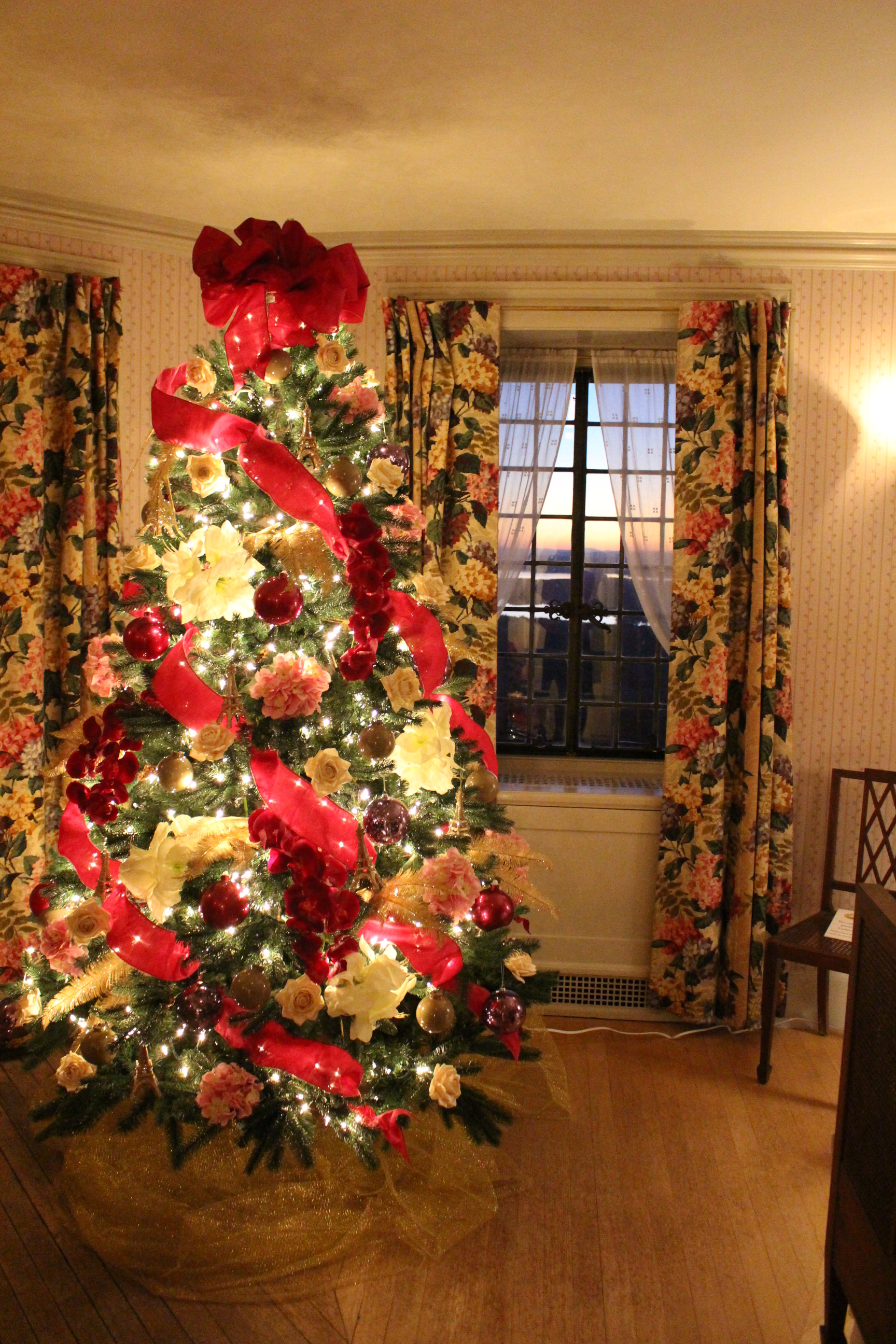
In the Lakes Region portion of the NH Heritage Museum Trail, Castle in the Clouds will celebrate its popular annual Christmas at the Castle program, which begins on Friday, November 16 with a Preview Party.
At this Preview Party, sponsored by Lifetime Benefits Group, visitors will get a first glimpse of the Castle with rooms decorated by local businesses and designers inspired by a theme of “Holidays Around the World.”
“There will be décor inspired by holiday traditions in Japan, Germany, Mexico and more,” said Castle Curator Robin Sherman.
She said incorporating other cultural traditions throughout the Castle pays homage to the appreciation that the Lucknow Estate’s original owners, Tom and Olive Plant, had for the wider world.
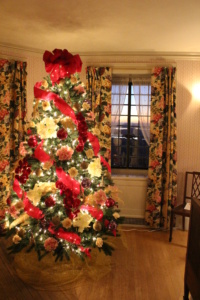
“We are excited to merge the history of the estate with the traditions of other countries and hope our guests enjoy experiencing these other cultures in an immersive and beautiful way,” she said.
All proceeds from the Preview Party will support the preservation and interpretation of the Lucknow Estate (Castle), which is now listed on the United States National Registry of Historic Places.
The holiday festivities continue on November 17 and 18 and the following weekend, November 23 to 25.
“Christmas at the Castle is one of the best events of the year for families and children,” said Stephanie Poole, programs and volunteer coordinator. “In addition to touring the Castle , guests may enjoy free activities in the Carriage House, including children’s holiday crafts, a visit with Santa Claus, cookies and hot cocoa, and an artisan fair.”
Featuring many NH-made items, such as candles, soaps, children’s toys, jewelry, cutlery and more, The Gift Shop will be open during Christmas at the Castle. Lunch will also be available at The Carriage House Restaurant.
Christmas at the Castle is supported by presenting sponsor, Infinger Insurance, and supporting sponsor, Leone, McDonnell & Roberts Public Accountants.
Noting this is just one of several holiday events throughout all three branches of the The Trail, Mike Culver, who serves as its president, said he hopes locals come see what visitors to already know.
“The Trail is about more than history,” he said. “We represent heritage and culture, and that includes nature, art and so much more. It’s a place for people of all ages.”
Comprised of 17 museums divided into three branches–Seacoast, Merrimack Valley and the Lakes Region–The Trail includes stopis in Canterbury, Concord, Dover, Exeter, Laconia, Manchester, Moultonborough, Plymouth, Portsmouth, Tamworth, and Wolfeboro.
To learn more about Christmas at the Castle, visit castleintheclouds.org.
Perhaps most well known for the White Mountains, the Granite State features a unique museum attraction known as the New Hampshire Heritage Museum Trail that is expected to attract 250,000 visitors in 2018.
Comprised of 17 museums divided into three branches–Seacoast, Merrimack Valley and the Lakes Region–The Trail is becoming a tourist destination, according to Mike Culver, its president.
“We have some incredible museums on The Trail, each covering aspects of New Hampshire history,” he said. “These aspects sometimes overlap, but each museum approaches it from a different perspective with an emphasis on making history relevant and fun to people of all ages.”
Located in Tamworth, about 15 minutes north of Wolfeboro, Remick Country Doctor Museum & Farm is the only country doctor museum in New England and one of only three in the United States.

“We provide year-round opportunities for visitors to engage with rural New England history, including the important contributions once made by country doctors, and present-day agricultural practices,” said Dawne Gilpatrick of the museum. “We do this through activities, tours, workshops, farm-to-table meals, educational programming and seasonal events.”
Set on a historical working farm, the museum property, barns, and buildings are “an explorers’ dream.”
“Visitors can wander the homestead grounds and interact with farm animals at their own pace and to their hearts’ content,” she added. “Exploration space includes many indoor and outdoor locations.”
Upcoming events at Remick include final sessions on November 2 in two separate “Field & Forest” programs.
In “Outdoor Walk—Plant ID,” participants will learn to recognize the abundance of useful, interesting, edible or medicinal plants on Remick grounds. In “Foragers Gathering,” participants will harvest wild, edible plants and then pair them with cultivated ingredients to create a nourishing food item.
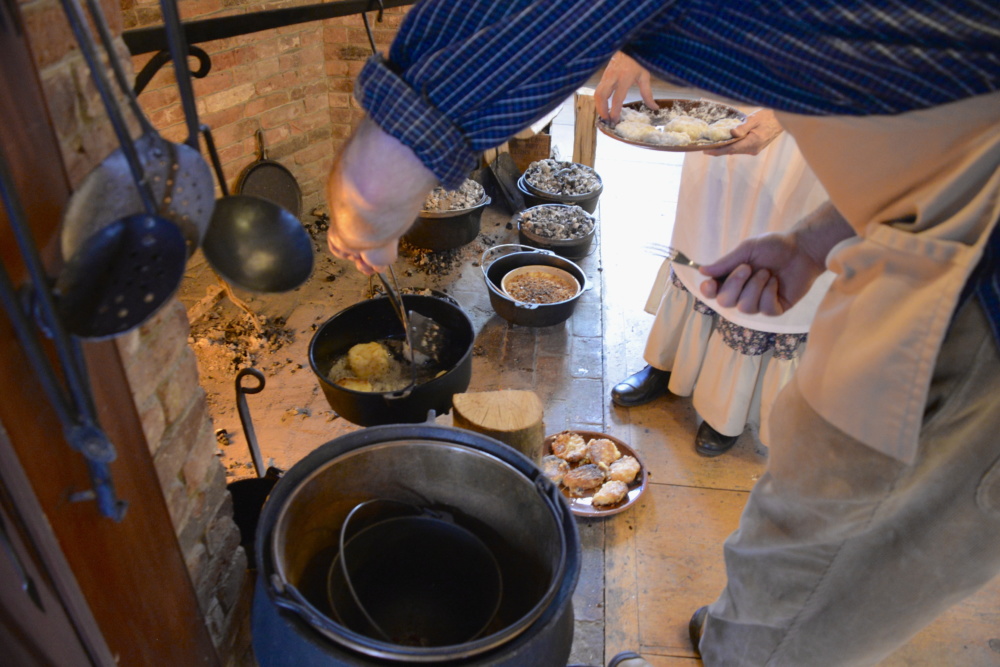
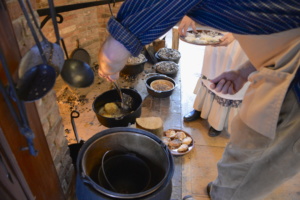
On November 17, Remick’s Hearthside Dinner season begins and runs through March. In this series, costumed museum interpreters take guests “back in time” to learn about 19th-century kitchens and food preparation, seasonal farming practices and foods, and historic cooking recipes and tools. Guests assist in preparing, cooking, roasting and baking foods in an open hearth with traditional tools before sitting down together to enjoy the fruits of their combined labor.
According to Gilpatrick, Remick and The Trail itself are important cultural assets to the state.
“We are providing experiences that not only enlighten visitors but educate them,” she said. “Museums are vibrant centers of the community.”
Culver agrees and added, “250,000 visitors each year can’t be wrong. We hope more people right here in NH can come see what many out-of-state visitors already know about The Trail–it’s fun.”
To learn more about Remick, or any upcoming event there, visit remickmuseum.org.
In total, 17 museums make up the NH Heritage Museum Trail. Stops on The Trail include Canterbury, Concord, Dover, Exeter, Laconia, Manchester, Moultonborough, Plymouth, Tamworth, and Wolfeboro.
Out of more than 15 museums on the New Hampshire Heritage Museum Trail, one of the most unique is The Woodman Museum in Dover, located in the Seacoast region of the state.
Founded in 1916 from a trust established by Annie E. Woodman, The Woodman features four historic houses, each one revealing a different aspect of history in the Granite State:
1.The Woodman House (1818) holds a military history gallery highlighting the Civil War through Vietnam and a collection of rocks, minerals, fossils, and taxidermy specimens (animals, aquatic life, birds, and butterflies).
2.The Damm Garrison House (1675), the oldest house in Dover, contains 800 artifacts from the colonial era.
3.The John Parker Hale House (1813), aside from telling the story of one of America’s foremost Abolitionists and ally of Abraham Lincoln (and whose daughter, Lucy was engaged to John Wilkes Booth), informs visitors of the socioeconomic history of Dover. It also provides primary examples of Portsmouth furniture and related art and artifacts.
4.The Keefe House (1825) contains a library where the museum stores its collection of the city records of Dover and Thom Hindle Art Gallery.
According to Mike Day of The Woodman, recent changes to The Woodman House itself are also of importance.
“We have recently finished phase 1 of the Woodman’s Accessibility Project, which saw new ramps and walkways,” he said. “These were designed to compliment the historic nature of the buildings on campus and installed in order to increase physical access to people of all abilities…Looking ahead,.the museum will seek funding for digital access to the upper floors.”
The Woodman’s programs reflect are equally accessible and of interest to all ages with one example its “Lives & Legends: Voices From the Museum.” At this event on Saturday and Sunday, October 20 and 21, visitors meet famous and infamous Dover citizens and historical characters in a 90-minute guided walk through 19 scenes spread throughout the museum’s campus.
In most scenes, denizens have come back from the dead to narrate their stories. In two scenes, however, these renowned Dover citizens are still alive with remarkable tales to tell.
To learn more about The Woodman, or any upcoming event there, visit woodmanmuseum.org.
In total, 17 museums make up the NH Heritage Museum Trail, which is broken down into three branches: Seacoast, Merrimack Valley and Lake Region. Stops on The Trail include Canterbury, Concord, Dover, Exeter, Laconia, Manchester, Moultonborough, Plymouth, Tamworth, and Wolfeboro.
In the Merrimack Valley portion of the NH Heritage Museum Trail, the Millyard Museum recently unveiled a new exhibit, “Manchester and the Great War,” which is open through the end of the year.
The exhibit’s run coincides with the 100th anniversary of the Armistice that ended the Great War on Nov. 11, 1918. According to John Clayton, executive director of the Manchester Historic Association, which operates the museum, items in the exhibit will include everything from weapons, uniforms and flags to photographs and other ephemera.
“The exhibit explores the impact of World War I on the city of Manchester and the many men from the community who took part in the conflict,” he said.
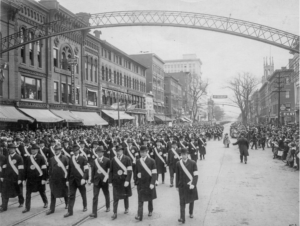
(The caisson bearing the flag-draped casket of Lt. William H. Jutras was the focal point of the somber funeral ceremony that was held at St. Raphael’s Parish in Manchester in 1921. Manchester Historic Association Photo.)
Lead curator for the exhibit is Manchester Historic Association (MHA) Research Manager Daniel Peters, an Army veteran and Purple Heart recipient who was wounded in combat in Afghanistan.
“The first World War is really a forgotten topic in our society,” said Peters. “More information is available about World War II mostly due to the large number of veterans who are still around. World War I participants are gone now, and history dies quickly if there isn’t a direct link to the days of the past.”
Each Saturday during the month of November, the Millyard Museum will host screenings of World War I films such as “Sergeant York,” Paths of Glory” and “All Quiet on the Western Front” to provide additional context on the Great War.
According to Mike Culver, president of The Trail and executive director of the Wright Museum of WW II, exhibits like“Manchester and the Great War” serve a deep purpose.
“The Millyard Museum, like all the museums on The Trail, helps provide a deeper context into various events throughout history,” he said. “There is also more to history than initially meets the eye, which makes The Trail such a fascinating resource for the state.”
The 15,000 square foot Millyard Museum features the permanent exhibit, Woven in Time: 11,000 Years at Amoskeag Falls, that tells the story of Manchester and the people who have lived and worked here.
For more information on “Manchester and the Great War,”visit www.manchesterhistoric.org.
In total, 17 museums make up the NH Heritage Museum Trail, which is broken down into three branches: Seacoast, Merrimack Valley and Lake Region. Stops on The Trail include Canterbury, Concord, Dover, Exeter, Laconia, Manchester, Moultonborough, Plymouth, Tamworth, and Wolfeboro.
[easy-image-collage id=1090]
For a small state, a lot of important things have happened in New Hampshire, much of which is captured in the collections and exhibits at the New Hampshire Historical Society in Concord.
One of 17 museums on The Trail, the Society holds the largest collection related to the history of the Granite State with more than 3 million objects, manuscripts, photographs, newspapers, and more. In commenting on what makes NH history so remarkable, Elizabeth Dubrulle, director of education and public programs at the Society, began with colonial history.
“During the colonial era, NH was renowned for providing thousands of mast pine trees for the British navy,” she said. “These trees helped the British navy expand to one of the largest in the world and allowed Britain to cultivate a vast overseas empire that stretched across the globe.
By the time of the American Revolution, however, she noted colonists no longer wanted to provide trees for the British, which led to the Pine Tree Riot of 1772.
“Locals in Weare refused to surrender their trees to the Crown and drove out of town the provincial official sent to claim the trees,” she explained. “In most of the Merrimack Valley, the controversy over pine trees was a local cause that made the American Revolution real for many people in NH.”Dubrulle also cited other colonial points of facts about NH, some of which include:
- Two-thirds of the American force at the Battle of Bunker Hill in June 1775 were from New Hampshire. Although the British eventually won that battle, the outnumbered American force had inflicted so many casualties that a British general commented, “One more such victory will cost us the war.”
- NH men also predominated in the Battle of Bennington of August 1777, which led directly to a major British surrender at the Battle of Saratoga two months later.
She also cited other NH facts and milestones, including:
- The first intercollegiate sporting event in American history occurred on Lake Winnipesaukee in the 1850s when Harvard beat Yale in a crew competition.
- NH saw the establishment of the first summer camps for kids starting in the 1880s. The idea was that city kids could spend a week or more every summer at a NH camp so they could get a taste of the “great outdoors.” The camp movement eventually spread to all over the United States.
- NH had the first abolitionist senator with John Parker Hale of Dover, who after 1846 spent his career arguing against slavery, which was legal in NH until 1857.
- The White Mountains inspired generations of artists and fueled a movement to establish state forests that would protect America’s scenic landscapes when the Weeks Act was passed in 1911. White Mountain art is considered one of the leading schools of 19th-century American art. When a British artist returned to England after a visit to the White Mountains and exhibited his painting of NH in the fall to Queen Victoria, she refused to believe that the trees could be so colorful. Luckily, he had brought back some fall leaves from NH trees to prove it to her.
For Dubrulle, though, there are compelling reasons for the study of history that go beyond facts and dates that she said underscores the importance of all member institutions on The Trail.
“Understanding how and why we got where we are today is essential to moving forward productively as a society,” she said. “A solid education in history gives people the critical insight they need to make good decisions about today.”
“The problems our ancestors faced are remarkably similar to the problems we still have today–immigration, jobs, poverty, a changing economy, clashing cultures, even substance abuse,” she added. “How did they cope with them, and what can we learn from them?”
In digging deeper into history and ourselves, she said we take a first step toward fact-based decision making, which provides both context and perspective. She said we also learn to take pride in the Granite State.
“NH has made a very significant impact on American history, and we should take note of that,” she said. “What happens here and what the people of the Granite State do has mattered.”
At the Society, two long-term exhibitions help tell a portion of NH’s story with “White Mountains in the Parlor” and “Discovering New Hampshire.” The former exhibit showcases some of the best White Mountain art in the world, while the latter features iconic objects from the state’s history.
In addition, a third short-term exhibit changes annually. This fall marks the final months to see “Making the World Safe for Democracy,” which uses dramatic posters of World War I to highlight how the people of New Hampshire participated in the Great War. The final day of the exhibit is Saturday, November 10 when the Society hosts Brandeis scholar Daniel Breen, who will speak about George Dilboy, the only NH recipient of the Medal of Honor during the First World War.
For Dubrulle, the diverse collections and exhibits at the Society underscore what people can discover at all museums on The Trail.
“At any given member institution on the New Hampshire Heritage Museum Trail, visitors are apt to encounter exhibits on art, war, and themes that touch on the urban landscape, agriculture and more,” she said.
She said even traveling between museums on The Trail offers people a chance to see why the New Hampshire landscape is so important to the people who live here. “We have everything from rugged seascapes to towering mountains, farms, riverbeds, gorges, lakes, and rock formations–we have it all on The Trail,” she said.
In total, 17 museums make up the NH Heritage Museum Trail, which is broken down into three branches: Seacoast, Merrimack Valley and Lake Region. Stops on The Trail include Canterbury, Concord, Dover, Exeter, Laconia, Manchester, Moultonborough, Plymouth, Tamworth, and Wolfeboro.
At any given member institution on the New Hampshire Heritage Museum Trail, visitors are apt to encounter exhibits that touch on art, war, and themes that touch on the urban landscape, agriculture and more.
According to Mike Culver, president of The Trail and executive director of the Wright Museum in Wolfeboro, an exhibit is much more than “a static display of historical artifacts.”

“Our first consideration is always the purpose of the exhibition,” he said. “Since education is the primary objective for any museum, our first consideration should always be: ‘How is what we are creating impacting and enhancing our educational mission?’”
Upon answering this question, he said what follows are the content and then aesthetics of an exhibit, each of which are “profoundly interwoven.”
At the American Independence Museum in Exeter, Executive Director Emma Bray said they are currently in the “unique and exciting position” to reinterpret all their permanent exhibition spaces.
“We are thoughtfully considering what story we want to tell and what the visitor takes away from their experience,” she said. “Perhaps it’s a new piece of information, or a spark to learn more about a topic.”
Noting there is a wealth of research on museum visitation about how different types of learners engage with museums, Bray said they are trying to provide as many opportunities for engagement as possible. This engagement is encouraged, she said, through traditional labels, digital interactives, and physical interactives.
“The interactives are still a work in progress, but we’re in an exciting phase of development and exploration,” she added.
For Culver, who noted they are also currently incorporating interactives into their exhibit spaces, it is important to “grab a visitor’s attention” almost immediately.
“This can be done in various ways – colors, images, sounds, but usually there is a combination of all of these elements,” he explained. “People learn in different ways–some by sight, some by text, some by the spoken word.”
Once they are drawn to the exhibit, he said visitors “unconsciously choose how they best learn and what they will ignore.”
“‘Bell and whistles’ may get them there, but it is the content they choose to absorb that will go home with them,” he said.
At the American Independence Museum, Bray said their hope is that their exhibits inspire visitors to learn more about the nation’s struggle for independence and its relevance to today.
“Civic engagement is another important outcome we hope to achieve,” she added.
Noting Wright Museum’s mission is to also demonstrate the relevance of a particular part of history–in their case, WWII–Culver said a well-designed exhibit results from “countless hours of study and planning.”
“You have to make sure the content is ‘king’ and worthy of visitors’ attention,” he said. “The exhibit must move them intellectually, emotionally, and creatively, so that they leave your museum wanting to know more and feel destined to explore topics on their own.”
Bray agreed and added, “Designing an exhibit is a wonderful challenge–and it is worth the effort when you see people experience those ‘aha’ moments.”
In total, 17 museums make up the NH Heritage Museum Trail, which is broken down into three branches: Seacoast, Merrimack Valley and Lake Region. Stops on The Trail include Canterbury, Concord, Dover, Exeter, Laconia, Manchester, Moultonborough, Plymouth, Tamworth, and Wolfeboro.
For those looking to explore the Merrimack Valley Region of The New Hampshire Heritage Museum Trail, the Currier Museum of Art in Manchester is currently installing an innovative new exhibit that opens on September 15.
Hauling is an installation by Ethan Murrow, a well known artist whose work may be found in many public, private and corporate collections throughout the world. It was influenced by the labor and industry of the Manchester region and created with the help of other artists, craftspeople, and historians from the area. Its most salient feature is a 100-foot long panoramic wall drawing and a 52-foot long drawing of rope imagery animated by a kinetic sculpture.
“The kinetic sculpture slowly rotating the 52-foot looped drawing is loosely based on looms and the newspaper printing press,” said Sam Cataldo, assistant curator at The Currier. “It also shares the basic mechanism of the machinery that powered the Amoskeag mills using the water of the Merrimack River.”

According to Cataldo, Murrow has drawn inspiration from Manchester’s complex history that includes colonial intervention, a home of native communities, rapid industrialization, post-industrial decline, and high-tech reinvention.
“He sees Manchester as an icon of the rise, fall, and reinvention of industrialization throughout the region’s history,” she said.
Regarding the exhibit’s collaborative nature, Cataldo said it reflects Murrow’s interpretation of the labor process behind building Manchester itself.
“Murrow recognized correlations with his own artistic practice of creating epic constructions requiring highly skilled craft and immense collaborative labor,” she said.
Currently, the exhibit installation process itself is open to the public with the exception of Saturdays. In addition, there will be a night event from 6 to 9 p.m. on September 6 during which visitors can the view the process and interact with Murrow.
To learn more about Hauling, which opens on September 15, visit www.currier.org.
The Currier is one of 17 museums on the NH Heritage Museum Trail with stops in Canterbury, Concord, Dover, Exeter, Laconia, Manchester, Moultonborough, Plymouth, Tamworth and Wolfeboro.
On Saturday, September 15 from 10 a.m. to 5 p.m., Canterbury Shaker Village will host the Canterbury Artisan Festival, which includes wagon rides, craft activities for children and adults, demonstrations of traditional Shaker crafts and more. The festival also features agricultural demonstrations, a juried craft fair and farmer’s market.
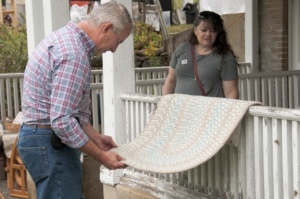
“We even have two teenage brothers who have revived the old arts of blacksmithing,” said Nicole Laurin, special events and adult programs manager at Canterbury Shaker Village. “There are many stories to be told here, which makes this annual event so interesting to people of all ages.”
For Sara Petipas of On the Cusp Pottery in Concord, the festival represents a unique opportunity to demonstrate the craft of wheel throwing.
“I will be making mostly vases, but potentially other forms such as bowls, pitchers and mugs,” she said.
For Petipas, the most rewarding aspects of pottery making are the processes themselves.
”The acts of wheel throwing and glazing are very meditative,” she said.
The most challenging part is the fragility of the process.
“There are many points in the process when things could go wrong–damage in drying, trimming, firing and transport of the finished pieces,” she added.
As for why she has returned to the festival for the past 6 years, she said she simply loves it.
“I enjoy working outside among the beautiful buildings,” she said. “Canterbury Shaker Village is a beautiful, peaceful place that lends itself well to the creation and appreciation of craft. It’s just gorgeous.”
For Laurin, Petipas’ appreciation of Canterbury Shaker Village is often experienced by visitors, which makes this annual festival so important to their mission.
“This festival showcases the “dynamic and vibrant” atmosphere of this place,” she said. “It represents the best of what we have to offer here.”
One of 17 museums on the NH Heritage Museum Trail, Canterbury Shaker Village is located in the Merrimack Valley branch of the New Hampshire Heritage Museum Trail.
Additional branches include the Seacoast and Lakes Region. Stops on The Trail include Canterbury, Concord, Dover, Exeter, Laconia, Manchester, Moultonborough, Plymouth, Tamworth, and Wolfeboro.
To learn more about the Canterbury Artisan Festival, which takes place on Saturday, September 15 from 10 a.m. to 5 p.m., visit
www.shakers.org.