The Lives of John and Lucy Hale

Portrait of John Hale

Abolition and Infamy:
The Lives of John and Lucy Lambert Hale

by

Woodman Museum logo

One of the four houses that comprise the Woodman Museum in Dover NH is the Hale House, Home of former U.S. Senator and Abolitionist John Parker Hale. Born on March 31st, 1806 in Rochester, NH, Hale would purchase the home in 1840 from the founder of the Dover Manufacturing Company, later known as the Cocheco Mill and Printworks, John Williams. Originally a Democrat in Congress, Hale was kicked out of the Democratic Party after he voted against annexation of Texas and the spread of Slavery. Hale would return later join the Free-Soil Party, a pro-abolition party, and run as a Presidential candidate in the election of 1852. He would ultimately lose to the election to his political rival in New Hampshire, Franklin Peirce. He would return to Congress in 1855 as a member of the Republican Party where we would serve until 1865.[1] Hale’s career is defined by his efforts to end the institution of Slavery in the United States, from introducing multiple legislative actions in Congress to serving as legal counsel for abolitionists and the Enslaved [2] However, there is a dark mark on the Hale family’s legacy.

Following the assassination of President Lincoln, John Wilkes Booth would be shot dead by one of the soldiers that found him.[3] Among the contents of his pockets, the soldiers would find a picture of Senator Hale’s daughter, Lucy. Why would the picture of the daughter of one of the most ardent abolitionist Senators be found in the pocket of a pro- Confederacy assassin? As historian E. Lawrence Abel argued, it was because the two carried on a secret love affair. Whatever the circumstances of their meeting were, Lucy Hale received a love letter on Valentine’s Day 1862 from Booth.[4] Despite attempts to cover up the discovery of Lucy Hale’s picture, word still got out.[5] In 1878, a series of news articles would accuse Lucy of the scandal and assert that she had been in a love triangle between Booth and Robert Todd Lincoln, Abraham Lincoln’s oldest son.[6]

You can learn more about Senator Hale and Lucy Lambert Hale by visiting the Woodman Museum in Dover, NH. Click here to visit the museum’s webpage for hours and admission information.


[1] “Hale, John Parker (1806-1873).” Biographical Directory of the United States Congress. 2019. http://bioguide.congress.gov/scripts/biodisplay.pl?index=h000034 Accessed 11 DEC 2019.
[2] Sewell, Richard H. “John P. Hale and the Politics of Abolition”. 1965. Harvard University Press. Pg. 152
[3] Abel, E. Lawrence. “John Wilkes Booth and the Women Who Loved Him”. 2018. Regnery History. Washington DC. Pg. 217
[4] Abel, E. Lawrence. “John Wilkes Booth and the Women Who Loved Him”. 2018. Regnery History. Washington DC. Pg. 177
[5] Abel, E. Lawrence. Pg. 219
[6] Abel, E. Lawrence. Pg. 248

Trail’s Newest Member Honors Families Who Built State’s Skiing Legacy

George Macomber

The New Hampshire Heritage Museum Trail’s newest member is celebrating the families who helped establish the state as a premier skiing destination. The New England Ski Museum will present its 2025 Spirit of Skiing Award to the combined McLane and Macomber families on November 22 at the Omni Mount Washington Hotel in Bretton Woods. The award honors the late Malcolm McLane and George Macomber, ski racing friends and patriarchs who teamed with fellow racers Mack Beal and Brooks Dodge to create Wildcat Ski Area in Pinkham Notch, which opened in 1957 with North America’s first gondola-type ski lift. Today, Wildcat still offers one of New England’s highest elevations, greatest vertical drops, and deepest snowpacks. “This award perfectly exemplifies why the New England Ski Museum is such a valuable addition to our Trail,” said Jeff Barraclough, President of the New Hampshire Heritage Museum Trail. “The McLane and Macomber families didn’t just build a ski area—they helped create the foundation of New Hampshire’s winter tourism industry and mountain culture. Their story demonstrates how individual vision and family dedication can shape an entire region’s identity and economic future.” The Ski Museum joined the NH Heritage Museum Trail in June 2025, bringing its comprehensive collection of ski history and 10th Mountain Division artifacts. With locations in Franconia and North Conway, the museum hosts more than 25,000 visitors annually with free admission, preserving one of the largest ski-related archives outside of Europe.
McLane at Dartmouth

McLane at Dartmouth

The McLane and Macomber families’ influence extended far beyond Wildcat, supporting ski racing across the region through leadership with the US Eastern Amateur Ski Association and the US Ski Team Foundation. Their children and grandchildren continue this rich tradition and will also be honored in November.

The Spirit of Skiing Award, inspired by legendary ski instructor Otto Schniebs, who said, “Skiing is not just a sport, it’s a way of life,” has been presented since 2006 to individuals who embody the true spirit of skiing. Past honorees include Waterville Valley founder Tom Corcoran, Norwegian Olympic gold medalist Stein Eriksen, and Olympic silver medalist Penny Pitou of Gilford.

“The Ski Museum’s membership strengthens our mission to connect the public with New Hampshire’s diverse heritage,” added Barraclough. “From the mountains to the seacoast, Trail members preserve the stories that define our state’s character and demonstrate how New Hampshire’s innovations and traditions have influenced the broader American experience.”

The November 22 event includes a reception with hors d’oeuvres followed by a buffet dinner in the Hotel’s grand ballroom. Tickets are $125 per person and can be purchased at skimuseum.org/sosa or by calling (603) 823-7177.

The New Hampshire Heritage Museum Trail connects the public with culturally rich heritage institutions across the state’s Lakes Region, White Mountains, Merrimack Valley, and Seacoast.
New Hampshire Heritage Museum Trail Offers Spooky Season Adventures Across the State

Ghosts on the Banke

From haunted historic neighborhoods to enchanted woodland walks, the New Hampshire Heritage Museum Trail offers families multiple opportunities to celebrate Halloween safely across the state’s Lakes Region, White Mountains, Merrimack Valley, and Seacoast.
“October is one of our most exciting months on the Trail,” said Jeff Barraclough, Trail President. “Our member museums have created unique Halloween experiences that combine history, education, and family fun in ways that showcase New Hampshire’s rich heritage.”

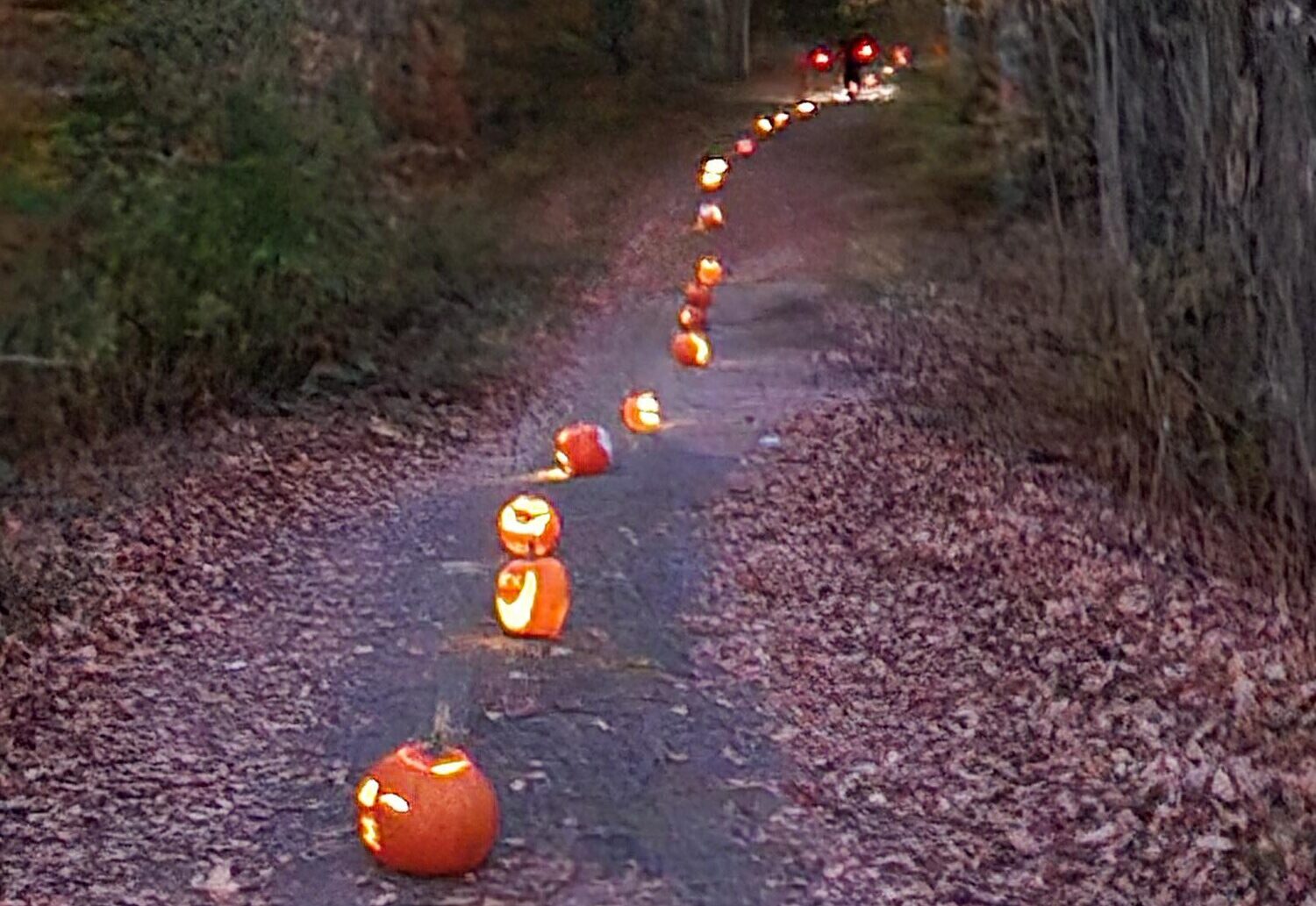
At Strawbery Banke Museum in Portsmouth, families can experience Ghosts on the Banke during two weekends: October 17–18 and 24–25. The event transforms the historic Puddle Dock neighborhood into a Halloween wonderland with hundreds of carved pumpkins, candle boxes, and string lights guiding visitors through safe trick-or-treating along candlelit lanes.

Castle in the Clouds

In the Lakes Region, Castle in the Clouds partners with the Moultonborough Recreation Department and Lakes Region Conservation Trust for their annual Pumpkin Walk on Friday, October 17. The family-friendly event features a Halloween-themed stroll through illuminated woods near Shannon Pond, complete with jack-o’-lanterns and not-so-scary surprises along the way.

Additional Trail museums are hosting special October programming—from historical ghost tours to harvest celebrations that provide families with educational and entertaining alternatives to traditional Halloween activities.

Portsmouth Historical Society: Cemetery Tours
Woodman Museum: Night at the Museum
Aviation Museum: Haunted Halloween Hangar 

“These events demonstrate how our museums bring history to life while creating safe, memorable experiences for families,” added Barraclough. “Whether you’re exploring a 350-year-old neighborhood or walking through enchanted woods, the Trail offers something special for everyone this Halloween season.”

The Trail’s Passport Program provides access to all member museums for just $25—a $150 value. Passports are available at participating museums and include brief summaries organized by location and category.

The New Hampshire Heritage Museum Trail connects the public with culturally rich heritage institutions across the state’s Lakes Region, White Mountains, Merrimack Valley, and Seacoast.

The Mount – Icon of Lake Winnipesaukee

The Mount Washington

The Mount – Icon of Lake Winnipesaukee

by

Lake Winni Museum Logo

For over 150 years, the Mount Washington has been cruising the waters of Lake Winnipesaukee, embodying the linked histories of lake transportation and tourism in the Lakes Region. Built by the Boston & Maine Railroad company, the SS Mt. Washington was launched in July 1872 to transport passengers and goods to key ports around the lake, as seen in early maps such as Calvert’s Map of the Lakes Region (1893). Tourism soon boomed at the Weirs transportation hub.

The Mount dominated lake transportation by the end of the 19th century, carrying more than 60,000 passengers annually. However, with the advent of automobile transportation and gradual decline of the railroad, the ship was sold in 1922 to Captain Leander Lavallee, who promoted area tourism with destinations around Lake Winnipesaukee. The original Mount burned at the Weirs landing in December 1939, where the fire also destroyed the wharf and railroad station.

Captain Lavallee then acquired the SS Chateaugay on Lake Champlain, and had that steamship cut into 20 sections and transported by train to Lakeport for reassembly. The new SS Mt. Washington II was launched in August 1940. The Mount has since undergone many changes, including lengthening and renaming as the MS Mount Washington. From a steam-powered sidewheeler to the 230-foot motorship today, the celebrated Mount endures as an icon of life on Lake Winnipesaukee.

New Hampshire Historical Society Opens “A Legacy of Landscapes” Exhibition

“A Legacy of Landscapes” exhibit at the New Hampshire Historical Society

The New Hampshire Historical Society, a member of the New Hampshire Heritage Museum Trail, has opened “A Legacy of Landscapes: Selections from the Linda and P. Andrews McLane Collection.”

Featuring 61 paintings by 41 different artists, the exhibition showcases selections from what is considered the world’s preeminent private collection of White Mountain landscape art. Assembled over several decades by Linda and P. Andrews McLane of Hebron, most of the works have not been on public view for many years.

“White Mountain landscape art is at the very core of New Hampshire’s identity,” said Jenn Walton, Assistant Director of Education and Public Programs at the New Hampshire Historical Society. “These artists were part of a broader cultural movement working to create a uniquely American identity, using our mountains as symbols of the nation’s limitless natural beauty and resources.”

The collection includes works by renowned artists such as Thomas Cole, Benjamin Champney, and Frank Henry Shapleigh. Highlights include Cole’s 1827 “Mount Chocorua, New Hampshire,” one of the earliest White Mountain landscapes ever painted by the artist known as the father of American landscape art.

The paintings range from sweeping views of the Presidential Range to intimate scenes of picnickers and farms, showcasing “every nook and cranny in the White Mountains, from Dixville Notch to Lancaster,” according to Walton.

Capturing moments when the White Mountain region seemed virtually untouched, the exhibition also documents the interplay between art and tourism development. “The artists are memorializing this pristine natural beauty, and those scenes lured visitors from cities to experience it firsthand,” she said.

The more visitors that came, though, the more the landscape changed, as “huge grand resort hotels, carriage roads and railroads, and hiking trails” were built to accommodate tourists. “In time, those scenic vistas that the artists and tourists alike held so dear were threatened,” explained Walton. “That dynamic is really fascinating.”
A New Hampshire native and Dartmouth College graduate, P. Andrews McLane has deep family ties to the state. His great-grandfather, John McLane, served as New Hampshire governor in 1904, where he helped secure funding for highway links to encourage White Mountain tourism.

According to Walton, the collection consists of more than 300 paintings by almost 100 different artists, with the first few exhibitions to serve as a sampling, highlighting its depth and breadth. “The collection, combined with the Society’s already existing holdings, offers all sorts of possibilities for future exhibitions, whether organized by region, artist, or theme,” she said.

Jeff Barraclough, President of the New Hampshire Heritage Museum Trail, said the exhibition demonstrates “the world-class collections that make New Hampshire’s cultural institutions so valuable.”

“The works in the McLane Collection not only capture New Hampshire’s natural beauty but also helped establish our mountains as symbols of American identity,” he added.. “It’s exactly the kind of unique heritage experience that Trail members offer throughout the state.”

“A Legacy of Landscapes” runs through December 31, 2025, at the New Hampshire Historical Society, 30 Park Street, Concord. Click here to learn more.

The New Hampshire Heritage Museum Trail connects the public with culturally rich heritage institutions across the state’s Lakes Region, White Mountain Region, Merrimack Valley, and Seacoast. Member museums showcase diverse heritage from art and history to science and industry, offering unique stories and unforgettable experiences for all ages.

Revolutionary War Veteran’s Journey Highlights New Hampshire’s Role in American Story

A Rendering of Peter Ayers’ House

Peter Ayers fought at Bunker Hill, Saratoga, and Yorktown before finding his calling at Canterbury Shaker Village, where he served for 65 years until his death at age 97. His remarkable journey from Revolutionary War battlefield to religious community exemplifies how individual stories shaped both New Hampshire’s heritage and America’s broader narrative.

Ayers’ story is the latest installment in the New Hampshire Heritage Museum Trail’s “25 Stories for 250 Years” initiative. Each month leading up to the 250th anniversary of the Declaration of Independence in 2026, The Trail shares stories about unique people, places, and events that demonstrate how New Hampshire’s story is America’s story.

Born in Connecticut in 1760, Ayers was already a battle-tested veteran at age 20 when he first encountered Shaker leader Ann Lee in 1780. Though intrigued by the Shakers’ vision, he returned to military service for the decisive Battle of Yorktown. After three more visits with Shaker leadership, Ayers converted and became a missionary for the Society.

In 1792, he accompanied Elder Job Bishop to formally establish Canterbury Shaker Village. Former New Hampshire Governor Isaac Hill described the 80-year-old Ayers in 1840 as “a most extraordinary man” with remarkable energy, noting “there was no scripture he could not quote in defense of his belief.”

“Peter Ayers’ story demonstrates the diverse paths that shaped early American communities,” said Erin Hammerstedt, Executive Director of Canterbury Shaker Village. “From defending our nation’s independence to helping establish one of New Hampshire’s most significant pacifist religious communities, his life shows how individual journeys contributed to our shared heritage.”

The “25 Stories for 250 Years” is a monthly series that invites audiences to learn more about the Granite State and its cultural institutions, weaving together stories that connect local heritage to the national American experience. Click here to learn more about “25 Stories for 250 Years”.

The New Hampshire Heritage Museum Trail connects the public with culturally rich heritage institutions across the state’s Lakes Region, White Mountain Region, Merrimack Valley, and Seacoast. Member museums showcase diverse heritage from art and history to science and industry, offering unique stories and unforgettable experiences for all ages.

New Hampshire Heritage Museum Trail Celebrates “Remarkable Summer,” Looks Ahead

Military Gallery of the Wright Museum of WWII in Wolfeboro

As summer draws to a close, New Hampshire Heritage Museum Trail President Jeff Barraclough called this summer “one of our strongest seasons yet,” marked by record visitor engagement and significant trail expansion.

“This summer has been remarkable,” said Barraclough. “We’ve seen tremendous growth in both local participation and out-of-state visitors discovering the incredible heritage stories our member museums tell. The enthusiasm has been infectious.”

The Trail’s popular Passport Program has been a particular success, attracting thousands of locals and tourists eager to discover museums they might not otherwise visit

Recent additions to the Trail, including the New England Ski Museum with locations in Franconia and North Conway, have expanded The Trail’s reach into New Hampshire’s rich snow sports heritage.

“Each new member institution brings unique stories and perspectives that strengthen our collective mission,” Barraclough explained. “The Ski Museum’s addition this summer has been especially exciting, connecting visitors to New Hampshire’s winter sports legacy while demonstrating how our smaller museums can pool resources for greater impact.”

Looking ahead to fall, Barraclough highlighted several initiatives designed to showcase New Hampshire’s diverse cultural landscape during the peak foliage season. “Fall is when New Hampshire truly shines, and our museums offer the perfect complement to the natural beauty visitors come to see,” he said. “We’re encouraging people to make their leaf-peeping trips more meaningful by discovering the human stories behind our landscapes.”

The Trail’s “25 Stories for 250 Years” initiative continues to unfold throughout the autumn months, offering visitors deeper connections to New Hampshire’s heritage as the state approaches its 250th anniversary.

“What excites me most is how our member museums are being recognized as significant cultural institutions that preserve and promote understanding of our national and state heritage,” Barraclough noted. “That recognition translates into increased support, better programming, and ultimately, more opportunities for people to connect with their history.”

The New Hampshire Heritage Museum Trail connects the public with culturally rich heritage institutions across the state’s Lakes Region, White Mountain Region, Merrimack Valley, and Seacoast. Member museums showcase diverse heritage from art and history to science and industry, offering unique stories and unforgettable experiences for all ages.

A Most Extraordinary Man

A close-up of Peter Ayers’ House (# 48) in Henry Blinn’s 1848 map of the Village.

A Most Extraordinary Man

by

Castle logo

In May of 1780, a young man named Peter Ayers met Shaker leader Ann Lee in the tiny community of Niskayuna, New York. Born in Voluntown, Connecticut in 1760, Ayers was 20 years old and a veteran of several Revolutionary War battles including Bunker Hill and Saratoga. After years of military service, Ayers was intrigued by the Shakers’ vision of a higher calling but was not ready to join the group.

In 1781, he returned to the army and served at the Battle of Yorktown. After three more visits with Shaker leadership, Ayers converted and became a missionary for the Society. In 1792, he accompanied his close friend Elder Job Bishop who was appointed to formally establish Canterbury Shaker Village. Over the next sixty-five years, Ayers proved to be an invaluable member of the community.

In August of 1840, former Governor of New Hampshire Isaac Hill published an account of the then eighty-year-old Ayers. Hill described him as “a most extraordinary man” with the energy of a person half of his age for whom “there was no scripture he could not quote in defense of his belief.”[1] Ayers died in 1857 at the age of 97.

[1] Isaac Hill, “The Shakers,” The Farmer’s Monthly Visitor 2, no. 8 (1840): 116. https://www.biodiversitylibrary.org/item/62626

Mt. Kearsarge Indian Museum Pow Wow Celebrates Community, Tradition, and Growth

Mt. Kearsarge Indian Museum’s 24th annual Pow Wow

The Mt. Kearsarge Indian Museum’s 24th annual Pow Wow drew more than 2,000 guests and over 250 participants this year, making the event one of New England’s largest Indigenous celebrations.

“Pow Wows are Native gatherings to celebrate Indigenous communities,” said Executive Director Andrew Bullock. “These family-friendly events include traditional dance, music, arts, and storytelling. They’re a chance for participants to renew acquaintances, make new friendships, and share culture with the public.”

The 2025 Pow Wow opened with a Grand Entry, followed by Flag and Veterans Songs, and featured specialty dances such as the Jingle Dance, Fancy Dance, Traditional Dance, and Fancy Shawl Dance. The MC guided attendees through the significance of each song and protocol, while vendors displayed pottery, beadwork, basketry, books, and jewelry.

Bullock emphasized the event’s cultural importance. “Traditional skills aren’t taught formally. Rather, youth learn by participating, emulating elders, and listening to storytellers,” he explained. “Pow Wows enable Native people to educate the public, share their views on environmental issues, history, and spiritual practices, and continue vital oral traditions.”

This year’s event included the participation of the Native American Women Warriors Association, who assisted with flag raising and led a panel discussion on supporting Native women in service. “Military veterans are important within the Native community,” Bullock noted. “We were honored to welcome members of this organization and highlight their work.”

The annual Pow Wow has grown over the years, reflecting the museum’s evolving reach. “Our first few Pow Wows had just a handful of participants and about one hundred spectators,” Bullock said. “Now, our Pow Wows now attract 200 to 250 participants from throughout the northeast, and we attract thousands of visitors each year. We also have a very active group of more than 50 volunteers.”

Mt. Kearsarge Indian Museum is open seven days a week through Saturday, November 1, with galleries featuring collections from across North America. This summer, visitors can explore the new exhibit, “The Sights and Sounds of Pow Wow,” which showcases contemporary Native regalia, drums, and music. Special events include live demonstrations and the Harvest Moon celebration on Sunday, September 28, featuring traditional foods, arts, and games.

“There are no Federal Indian reservations in the state,” Bullock said. “Without a land-base or state recognition, Pow Wows like ours provide a vital gathering space for Native people to dance, share ideas, and educate the public. We look forward to welcoming everyone to experience these traditions.”

Mt. Kearsarge Indian Museum is dedicated to connecting people of all backgrounds with Native American history, culture, and art in Warner, NH. For more information on upcoming events, visit indianmuseum.org.

Member institutions on The Trail are located in New Hampshire’s Lakes Region, Merrimack Valley, and Seacoast.

Coming Together to Preserve Local History

Coming Together to Preserve Local History

by

Castle logo
Sometimes it takes a community to decide that history is worth saving. In 1917, an iconic Georgian home at the corner of State and Middle Streets in Portsmouth—built in 1758 for merchant Gregory Purcell—was at risk of demolition. Believed to have hosted American naval hero John Paul Jones while his ships were under construction at the nearby naval yard, the house had long been part of the city’s historic fabric. Concerned citizens rallied to stop a local insurance company from destroying the house and building a brick office building on the property, thanks to a generous gift from a descendant of former owner Woodbury Langdon. That moment sparked the founding of the Portsmouth Historical Society, which opened the home as a museum in 1920. It is of historic note that there is no definitive evidence to support the claim that John Paul Jones stayed there. Today, the Portsmouth Historical Society continues that spirit of civic action by preserving local history, sharing stories through exhibitions, and engaging the community. None of it would be possible without the determination of those early citizens who believed Portsmouth’s past was worth protecting.

Passport Program Offers Residents and Tourists a Gateway to New Hampshire’s Museums

The entrance at New Hampshire Boat Museum in Moultonborough

A single ticket is opening doors to New Hampshire’s history, art, and culture, as the New Hampshire Heritage Museum Trail’s Passport Program provides residents and visitors with access to nearly two-dozen museums.

According to Jeff Baraclough, Trail President, the Passport attracts thousands of locals and tourists eager “to discover museums they might not otherwise visit.” “It encourages people to experience the full range of what New Hampshire’s museums have to offer,” he explained. “From small local collections to major cultural institutions we have a rich and diverse array of institutions on The Trail.”

Available for $30 at participating museums across the state, the Passport grants free admission to each of the 22 Trail institutions throughout the year. The program is designed to encourage exploration, with each passport including summaries of the museums and a spot for a commemorative stamp at every stop.

“The Trail passport is like a gateway,” said Jenn Walton, Assistant Director of Education and Public Programs at the New Hampshire Historical Society. “There are so many different types of organizations represented—history, art, architecture, sports—there is something for everyone.”

Devon Kurtz, Executive Director of the New Hampshire Boat Museum, said the Passport connects the state’s unique history and culture. “The museums on the Trail not only complement each other, they build off each other and tell a more complete story,” he added.

Click here for more information about the Passport Program and participating museums.

Member institutions on The Trail are located in New Hampshire’s Lakes Region, Merrimack Valley, and Seacoast.

New England Ski Museum Joins New Hampshire Heritage Museum Trail

The New England Ski Museum in Franconia Notch State Park

The New England Ski Museum, with locations in Franconia and North Conway, has joined the New Hampshire Heritage Museum Trail, expanding the Trail’s reach into the state’s rich history of snow sports.

Founded in 1977 in Franconia and expanded to North Conway in 2018, the Ski Museum documents the history of skiing and snowboarding in New England and beyond. Highlighting both permanent and rotating content, exhibits range from Olympic memorabilia to design elements in ski culture.

Executive Director Andrea Masters, who stepped into the role in 2024, said the Ski Museum is enthusiastic about joining the Trail. “We’re very excited,” she said. “This is why we all live and work in New Hampshire—we like rural life and smaller communities.”

Noting that the majority of museums on the Trail are “smaller,” she said their membership is “a chance to stick together.” “We can pool our resources—intellectual and financial—for joint outreach,” she added.

Regarding what people can expect at the Ski Museum, Masters cited new exhibits, one of which just opened in Franconia that focuses on the rapid growth of ski resorts in the 1950s and ’60s. A corresponding exhibit in North Conway—opening in July—will feature the evolution of ski area logos.

“We also have a current exhibit in North Conway on Slim Aarons, who was a very famous photographer in Hollywood,” she explained. “He also did photography ski photos and winter shots, so we are exhibiting those at the moment.”

In looking to the future, Masters expressed enthusiasm, citing a new website in development and a long-term goal to digitize their collection. Featuring more than 3,000 books, 3,468 reels of ski film, thousands of photographs and posters, and historic scrapbooks, the collection also includes personal memorabilia from the 1936 U.S. women’s Olympic ski team.

“We want to make our collection accessible to people everywhere,” she added. “It’s a multi-million-dollar project, but we believe it’s worth it.”

To learn more about the Ski Museum, visit skimuseum.org.

Member institutions on the New Hampshire Heritage Museum Trail are located in New Hampshire’s Lakes Region, White Mountain Region, Merrimack Valley, and Seacoast.